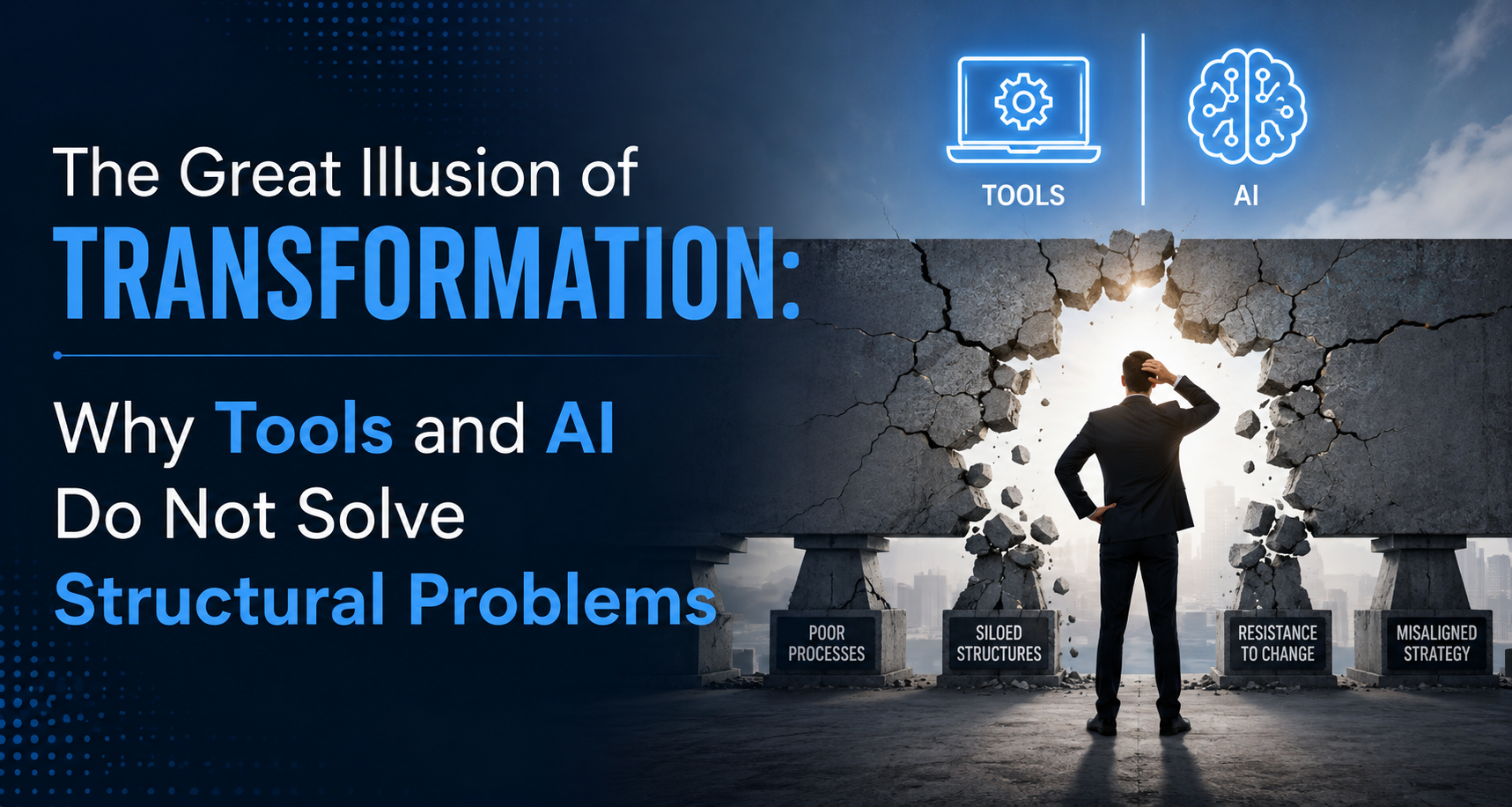
The Great Illusion of Transformation: Why Tools and AI Do Not Solve Structural Problems
By Marcelo Correa
After nearly 20 years working with ITIL, and since 2017 primarily leading ServiceNow implementations across companies of different sizes, industries, and countries, one conclusion has repeated itself almost universally:
Technology is rarely the problem.
Despite multimillion-dollar investments in ITSM and ESM platforms, automation, and more recently Artificial Intelligence, many organizations continue to face the same operational challenges they had a decade ago. Slow processes, poor user experiences, inconsistent data, fragmented knowledge, and a low perception of value from the business.
The question I constantly ask myself is simple:
How can organizations invest so heavily in technology and still achieve such modest results?
The answer, more often than not, lies in how we approach transformation.
The Obsession with the Tool
In countless initiatives I have participated in, approximately 90% of the effort was directed toward the platform itself.
We discuss:
-
How to configure workflows
-
How to customize forms
-
How to build dashboards
-
How to automate approvals
-
How to create integrations
-
How to implement new modules
Yet we spend far less time on much more important questions:
-
What business problem are we trying to solve?
-
How should this process work end-to-end?
-
Is the required data reliable?
-
Is there structured and accessible knowledge?
-
Are people prepared to work differently?
-
Is leadership truly committed to change?
Too often, the tool becomes the center of the transformation.
And that is a mistake.
Technology should be an enabler of organizational capabilities. It should never become the ultimate objective.
The Maturity That Is Still Missing
Even after years of evolution in the ITSM and ESM market, it remains relatively uncommon to find organizations that are truly mature in fundamental capabilities such as:
-
Service Portal
-
Service Catalog
-
Service Desk
-
Incident Management
-
Request Management
-
Problem Management
-
Change Enablement
-
CMDB
-
IT Asset Management
-
Knowledge Management
-
Service Level Management
-
Measurement and Reporting
Many implementations are visually impressive.
The portals are modern. The dashboards look great. The workflows are sophisticated.
But when we examine the operation more closely, we often find:
Catalogs that nobody uses. Outdated CMDBs. Abandoned knowledge bases. KPIs that do not drive decisions. Overly complex processes. Automations that merely accelerate existing inefficiencies.
In other words, we have sophisticated platforms built on fragile foundations.
Technology Never Operates Alone
Every sustainable transformation is built upon six fundamental pillars.
Strategy
Before any implementation, organizations need to answer:
Where are we trying to go? What business outcomes are we seeking? How will technology contribute to those outcomes?
Without strategic direction, technology becomes just another project.
Organizational Culture
Transformations fail because people and organizations have deeply ingrained habits.
New tools do not eliminate old behaviors.
Without a culture that embraces change, collaboration, and continuous improvement, any initiative will inevitably face resistance and low adoption.
People
No platform replaces capable people.
People are the ones who:
-
Identify real problems
-
Make decisions
-
Share knowledge
-
Create improvements
-
Connect business needs to technological capabilities
Investing in technology while neglecting capability building is like buying a Formula 1 car without having trained drivers to operate it.
Processes
Automation does not fix broken processes.
It simply executes them faster.
Overly bureaucratic, poorly designed, or inconsistent processes remain problematic regardless of the technology being used.
Before automating, you need to simplify.
Before simplifying, you need to understand.
Data
Data is the raw material of digital operations.
Without trustworthy data:
-
Reports lose value
-
Metrics become distorted
-
Decisions become questionable
-
Automations fail
-
Artificial Intelligence produces inconsistent results
Bad data creates bad decisions.
Always.
Knowledge
Perhaps no asset is as neglected as organizational knowledge.
Fragmented, outdated, or inaccessible knowledge leads to:
-
Longer resolution times
-
Excessive dependence on specific individuals
-
Repeated mistakes
-
Lower productivity
-
Poor experiences for both users and employees
Mature organizations treat knowledge as a strategic asset.
Artificial Intelligence Is Following the Same Path
Today, I see a very similar situation unfolding with Artificial Intelligence.
There is enormous enthusiasm.
There are also unrealistic expectations.
In many organizations, AI is being treated as a kind of magic wand capable of:
-
Immediately reducing costs
-
Solving historical operational problems
-
Improving user experiences
-
Dramatically increasing productivity
-
Replacing complex human activities
But reality is much harsher.
Artificial Intelligence does not fix structural deficiencies.
It amplifies the existing reality.
If processes are poor, AI accelerates poor processes.
If data is inconsistent, AI produces inconsistent answers.
If knowledge is fragmented, AI delivers unreliable responses.
If governance is absent, AI amplifies risks.
If people do not trust the information being generated, adoption simply does not happen.
AI does not create organizational maturity.
It depends on it.
The Future Will Not Be Won by the Best Tool Alone
The organizations that benefit the most from Artificial Intelligence will not necessarily be those that purchase the most sophisticated platforms.
They will be the ones that build strong foundations.
The companies that extract real value from AI will invest simultaneously in:
Strategy. Governance. Processes. Data. Knowledge. People.
True digital transformation has never been about technology.
And the Artificial Intelligence revolution will not be either.
At the end of the day, platforms do not transform organizations.
People transform organizations.
Technology simply amplifies what they are already capable of doing.
About the author:

Marcelo Correa is a technology strategist with over 20 years of experience and a strong track record in ITSM/ESM, service automation, and digital transformation. Over the past 15 years, he has led process modernization programs, platform implementations, and IT governance evolution across major companies in Latin America and Europe.
With both practical and strategic focus, Marcelo has worked as an ITIL expert for more than 15 years and as a ServiceNow specialist for over 8 years, leading ITSM, CSM, RPA, and business process automation journeys, as well as integrations with platforms like SAP, Salesforce, and UiPath. He has led multimillion-dollar projects that delivered significant results in productivity gains, cost optimization, and improved customer and user experiences.
He holds an ITIL Expert certification, an MBA in Digital Business, and a postgraduate degree in IT Governance. Through his content, he shares insights and strategies for leaders who aim to maximize the value of ITSM/ESM platforms and transform their operations by focusing on people, data, and optimized processes.